Philosophy & interpretation of our transcriptions
Bhajans are spiritual songs from India. Various names and aspects of God are invoked and worshipped. Often the texts consist solely of names of God, hence their effect to concentrate the mind on God and fill the heart with love.
The translation at the end of each bhajan is an attempt to convey the meaning of these names or aspects of God, as well as to provide some mythological background knowledge. Line breaks in the bhajan are marked with slashes / in the translation. The main aspect worshipped in each bhajan is written at the top right after the title.
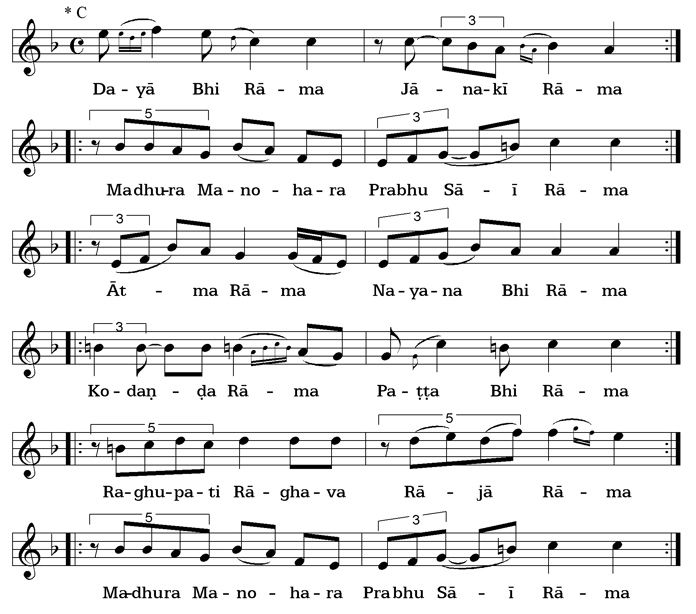
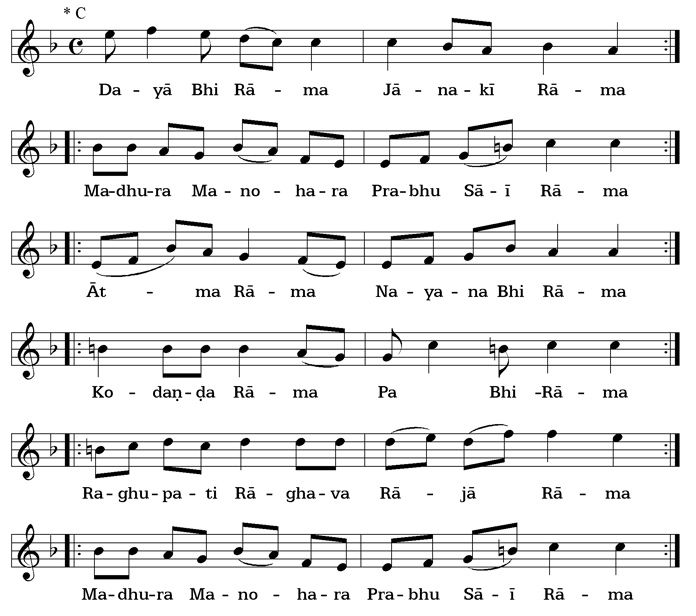
How to interprete the signs used on the music sheetsUsually, the precentor sings one line and then the group repeats it. The end of each line is marked with a repeat bar line :|| or with a double bar line ||.
The whole bhajan is first sung at slow or medium speed and usually each line is repeated. Then the bhajan is sung again at a faster speed, this time usually without repeating the single lines.
Lines without repeat sign are not repeated even at slow speed.
To conclude the bhajan the last line is repeated and then everyone sings the first line (and sometimes also the second line) slowly.
Repeat signs with asterisks *||: A || B :||* signify the sequence A B A B.
By the sign |- - - -- - - -| an interjection is marked. This is usually only sung in the fast repetition of the bhajan: whole line, interjection, whole line again.
When there is a change from full beat to upbeat, the entry is marked by a dashed line. In the reverse case (when changing from upbeat to full beat) the additional note is added at the end of the line. These notations replace the usual brackets for first and second endings.In some bhajans alternative melodic turns are notated with rhombus note heads. Grace notes are suggestions for ornamentation and not to be copied literally. Grace notes usually start on the beat, not before the beat like in western classical music.
Accompanying with instruments
As in all Indian music, bhajans are based on a rāga, although not in the strict classical form. An essential element of this is the reference to a constant drone or ground-note. Every note of the song gets its value and expression from its relationship to this ground-note. Thus, classical Indian music is modal, i.e. not harmonic like western classical or popular music. When accompanied by tānpūrā or harmonium, this drone is constantly present, usually also the fifth (P), in some bhajans the fourth (m).
To make it easier to grasp the melodic structure and the mode or rāga, all bhajans are uniformly written with C as ground-note (drone).
For each bhajan we suggest possible drones suitable for group singing. Our suggestions avoid tones lower than G and higher than Eb. Indian singers tend to sing higher pitches, elder western non-professional singers tend to lower pitches. With a scale shifter harmonium most transpositions can be done.
Indian music also uses various non-diatonic scales. The name of the mode or ṭhāṭ (tone scale) is written after the title of the bhajan, also the tone scale in Indian Sargam (e.g. S R g m P d N S’). The corresponding accidentals are marked at the beginning of each line of the notes.
When the bhajans are accompanied with a guitar or similar harmonic instrument, the modal structure should be kept in mind.
We are aware that certain bhajans with their scale material can sometimes be harmonized beautifully for harmonium or guitar. But we leave the creative elaboration of changes to the individual player, because there are lots of different possibilities to do so depending on the instrument, the way of playing or the skill and knowledge of the arranger.
NumberingIn Bhajan Book I, II+x and III, the bhajans of each volume are alphabetically ordered and numbered. In the new complete Bhajan Book 2026 all Bhajans have new alphabetical numbers. Here you can download a number conversion list.
Transliteration and Pronunciation of the Sanskrit and Hindi texts
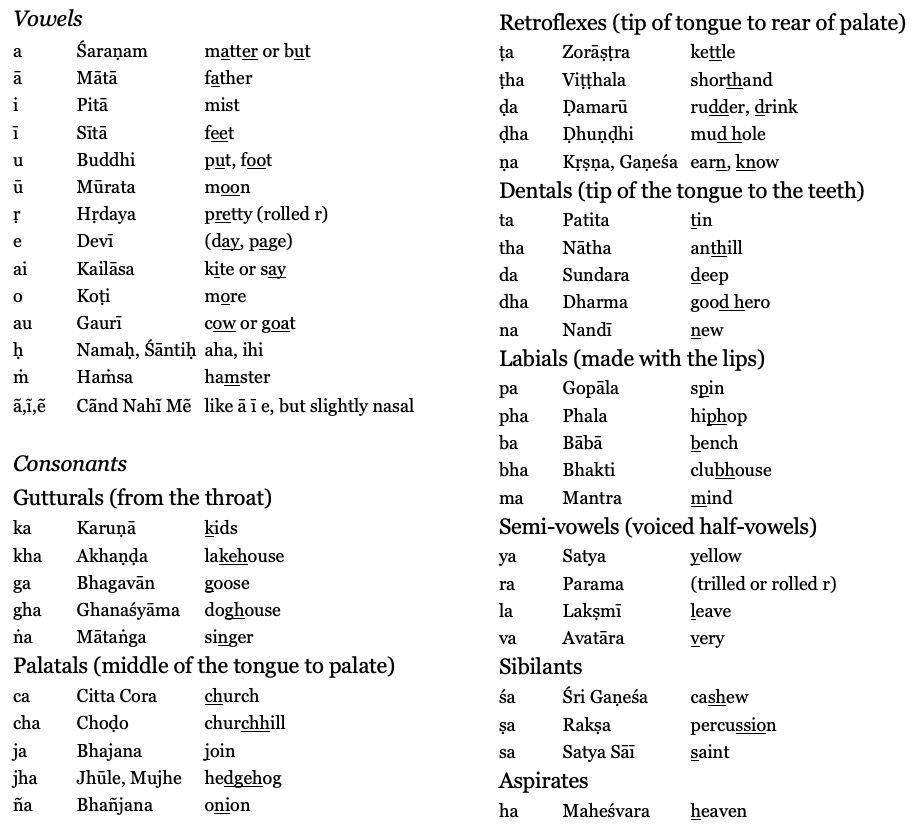
The Bhajan texts in this book are written in the internationally used scientific transliteration (IAST) of Indian scripts. Using the table on the right side helps to learn the correct pronunciation. The most important rules:
• ā, e, ī, o, ū are always long and usually mark the stressed syllable
• a, i, u are short, the sound of a is somewhat open (like in matter)
• ś, ṣ, c, ch und ṛ: see on the table
• t und d are mostly dental: tip of the tongue towards the teeth (i.e. ṭ and ḍ are rare)